Be yourself; Everyone else is already taken.
— Oscar Wilde.
This is the first post on my new blog. I’m just getting this new blog going, so stay tuned for more. Subscribe below to get notified when I post new updates.
Be yourself; Everyone else is already taken.
— Oscar Wilde.
This is the first post on my new blog. I’m just getting this new blog going, so stay tuned for more. Subscribe below to get notified when I post new updates.

INTRODUCTION
Assalamualaikum, and a very good day to you.

My name is Raja Mohamad Arash bin Raja Azlan Shah, but most people called me Arash. I am truly sorry if my English is not easily understandable. I have two siblings and I am the youngest. I was born in Taiping, Perak but raised in Kuala Lumpur. My secondary school is SMK Taman Setiawangsa and one of the librarian in the school. I studied at UiTM Tapah, Perak and my course here is Computer Science. The Lecturer who teach me is Pn. Khairulliza Ahmad Salleh & En. Zaaba Ahmad. The purpose I am writing this is to tell you about UED102-Study Skills Portfolio.
High School vs College

CONTENT IN UED102
TOPIC:
1. Getting Ready To Learn
-Learning Style Inventory
2. Goal Setting
– Goal Statements – The Five Step Approach
3. Library & Campus Resources
– Notes on Library Tour
4. Time Management & Organizational Skills
– Fixed-Commitment Calender
– Job Task Analysis
– Prioritized To-Do List
5. Memory, Learning & Improving Concetration
– Memory Strategies (Activity 4-1: Van Blerkom, 2009, pg. 90)
– Organizational Strategies (Activity 4.7: Van Blerkom, 2009, pg. 107) – optional
– Concentration Strategies (Activity 6.1: Van Blerkom, 2009, pg. 144)
– Concentration Chart (Figure 6.4: Van Blerkom, 2009, pg. 161)
– Reading Text (Figure 12.3: Van Blerkom, 2009, pg. 309)
6. Taking Lecture Notes
– Note-Taking Strategies (Activity 5-1: Van Blerkom, 2009, pg. 116)
– Note-Taking Exercise Using the Cornell Method
7. Academic Integrity & Performance
– GPA Worksheet
TOPIC 1: Getting Ready To Learn
Learning Style Inventory
8 Steps To Varsity Success
Attend All Classes
– Though cutting class is sometimes tempting, don’t do it if you can help it. Save absences for when you’re sick or when you have an emergency that cannot avoid. When you miss class, you miss lectures, notes, explanations of assignment, class discussions, and sometimes quizzes and in-class assignments. Getting copies of a classmate’s notes won’t always help.
Become An Active Learner
– Arrive early or on time and sit in the front whenever you can.
– Meet your instructors during their office hours. Making sure they know your name is an indicators that you’re commited to learning.
– Join study groups and discussion groups based on the class subject, and be an active group member.
Participate In Class
– Ask question that you’re curious or don’t know in class as it will help to make your learning easier to understand.
– Take note of your classmates questions when they asking the lecturer/instructor.
Get To Know Your Lecturer
– You will be more comfortable asking for help whether it is in class or in the lecturer’s office.
– Easier for you to succeed in their classroom.
Form Study Groups With Friends
– Forming study groups with friends will make your studying more alive. You can discuss and change of opinion with them. You also can generate more ideas to solve hard questions.
Stay Up To Date With Your Work
– Staying up to date with you work is very important. The amount of work or assignment will be a lot if you delaying your work. Don’t delay your work even if it is a simple and easy task.
Be Receptive To Change
– You can try using various learning style that suits you the most to cope with the studies.
Work hard this semester
– Working hard on every semester is a must for all student. Your hard work will pay off when you got good grades and passed with flying colours.
Learning Styles

Visual:
–Visual learners will typically retain more information when they can see something that graphically understandable what they are trying to learn. Visual learners should study using visual aids whenever possible.
Auditory:
–Auditory learners will retain more information when they hear something. For them the best way to learn is to hear something over and over. Using a tape recorder and reading out loud would be really helpful.

Kinaesthetic:
–Kinaesthetic learners will retain information when they use the hands-on approach such as demonstration.


TOPIC 2: Goal Settings
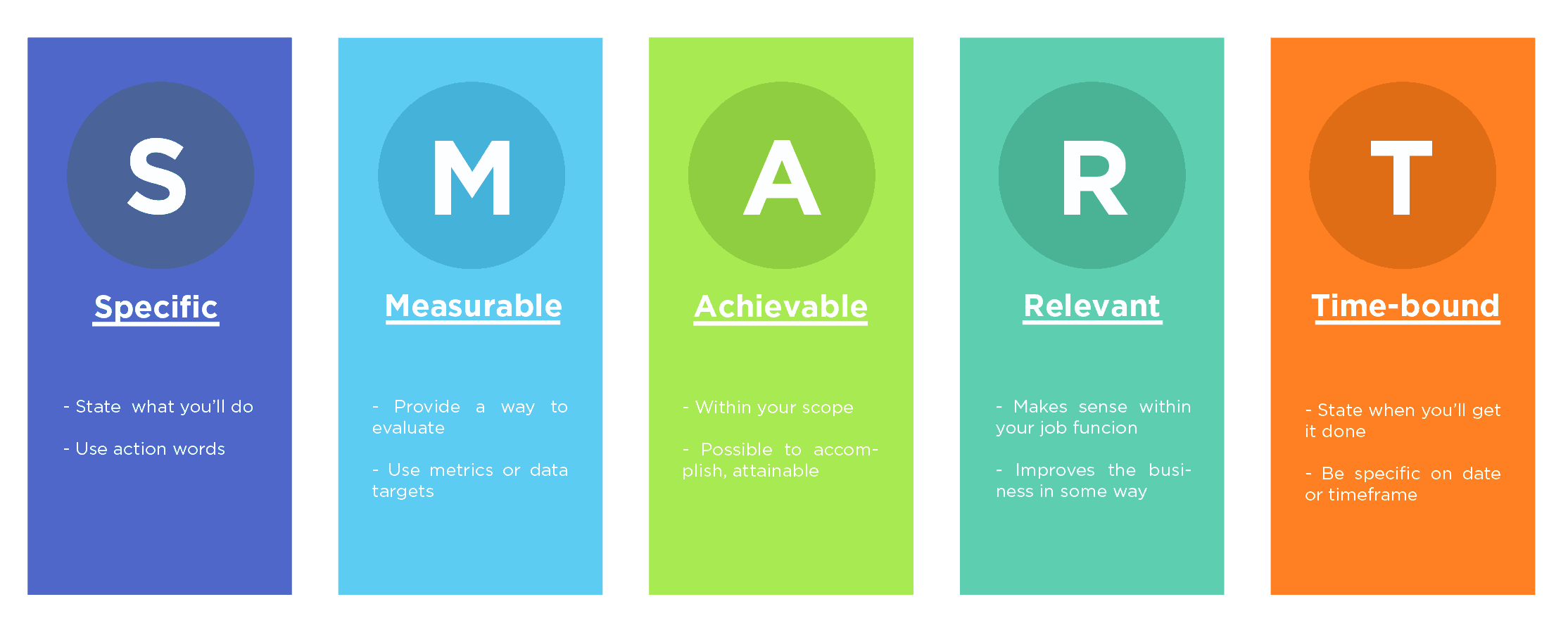
Goal Statements – The Five Steps Approach

Specific:
– Goals that are specific have a significantly greater chance of being accomplished.
Measurable:
– A SMART goal must have criteria for measuring progress. If there are no criteria, you will not be able to determine your progress and if you are on track to reach your goal.
Attainable:
– A SMART goal must be achievable and attainable. This will help you figure out ways you can realize that goal and work towards it. The achievability of the goal should be stretched to make you feel challenged, but defined well enough that you can actually achieve it.
Relevant:
– This step is about ensuring that your goal matters to you, and that it also aligns with other relevant goals. We all need support and assistance in achieving our goals, but it’s important to retain control over them. So, make sure that your plans drive everyone forward, but that you’re still responsible for achieving your own goal.
Time Bound:
– A SMART goal must be time-bound in that it has a start and finish date. If the goal is not time constrained, there will be no sense of urgency and motivation to achieve the goal.
The Five-Step Approach To Setting Goals
1. What you want to accomplish.
2. Know the obstacles.
3. Find enough resources.
4. Review and revise again.
5. Post goals is a must.
Develop An Action Plan
+ Set action tasks.
+ List the materials you need.
+ Set time frames.
+ Evaluate
TOPIC 3: Library & Campus Resources
Notes on Library Tour (Library of UiTM Perak@Tapah)
One of the main interest here is the library. The name of this library is “Perpustakaan Tunku Abdul Rahman”. Things like computer lab, books and discussion rooms can be found and can be used here. Besides, many types of book are in this library. Students can easily borrow books for their assignment and task. Below is the picture that shows PTAR.

The Library division has existed in line with the establishment of UiTM (Perak) Tapah campus. The temporary name is “Resources Center” and located next to the UiTM campus (Perak).From 18 April 2014, the division moved from Phase 1 building to Phase 2 building.
On 20 May 2014, the Library Division commenced operations in a permanent building located between the Administration office and the Lecturers building that could accommodate about 650 students at one time. It is managed by 2 librarian and 7 supporting staff. The building has three floor that houses six main units, namely the administration Unit, information Services Unit, customer service Unit, Journal and Database Unit, system and information technology Unit and material conservation Unit.
Organization Chart of PTAR

Facilities And Services In The PTAR
These are some of the facilities that can be found in PTAR:
Discussion Room (LeVeL 1)
i. 2 room in PTAR.
ii. Limit hour of using this room is 2.
IC Room (LeVeL 2)
i. 40 unit computer that are free to use.
ii. 2 unit of print and photography machine for student use at a reasonable price.
iii. 2 unit of scanner machine.
iv. 6 unit facilities of Streamyx and campus WiFi without password.
Things That Students Must Know About PTAR
1. O p e r a t i o n T i m e

2. B o r r o w i n g & R e t u r n i n g B o o k
Borrowing
At the PTAR, we can borrow and renew the date to borrow the same book through the counter or through online or the self-check machine. But there are 3 conditions that need to be followed if we want to renew the same book.
– Limit to the first renewal of the book.
– The book is not through returning status.
– Other users does not make reservations.
If you want to borrow a book you just need to bring your matric card to the counter or you can self service by using the self-check machine near the counter.
Returning
You can return the book at the counter or at the Book Drop Machine. The book must be return within the lending period due date.
How to Find A Book And step to borrow it?
1. OPAC
2. Racks
3. Counter/ Self-Check Machine
4. Receive the lending period
Penalty (Student Only)
+ 20 cent per day.
+ Warning notice will be send.
+ Suspend from the borrowing convienence.
+ Warning letter will be send to the parents/guardian.
+ Your name will be send to HEP department for the displinary action.
Missing Book Or Lost Your Book
~ You must report the missing or lost book to prevent the penalty amount increase abruptly.
~ The compensation that you had to pay:
The market price + processes fee + penalty (if available).
The Borrowing Process Between The Libraries
If you want a book that cannot be find at the library you can request it. They will try to find the book from another library.
Searching Book Or E-book And Databases
In PTAR website you can easily search book using OPAC system. Link to the website: http://library.perak.uitm.edu.my/v1/index.php . Besides, online database can be find using the website.
TOPIC 4: Time Management & Organizational Skills
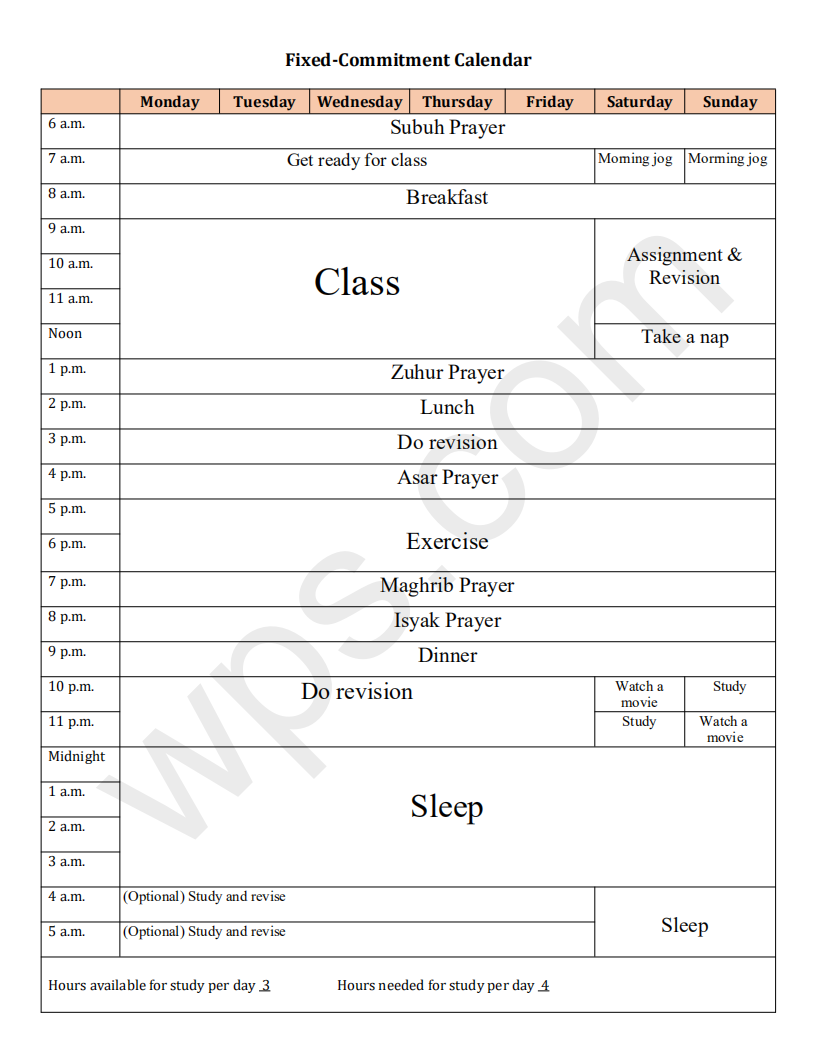
Fixed-Commitment Calender
Time Management
The right duration for sleep is 6 to 7 hours a day.
Plan your day wisely such as planning ahead daily planning, semester planning, the whole semester planning and weekly planning.
Daily Planning
– Set level of priority for the things that you need to do. You can use the 5W and 1H of Kaizen method (What, When, Where, Why, Who,How).
– Knowing your weakness also helps to overcome it with more success rate.
Semester Planning
– Ask for help from senior to help you to improvise yourself.
– Follow the timetable. You can also follow the timetable flexibly to your time wise.
The Whole Course Planning
– You need to know the killer subject that is hard for you so you can study and also ask help from friends or lecturer or senior. The killer subject is related to MAT.
– You need to bear with GPA target to easily scored and achieve good GPA and also good grades.
– Improving English language is a must for all student because most of our subject is in English language.
Reason of Procrastination
– Forgeting parents hard work.
– Bad attitude.
– Does not follow the schedule that you make.
– Following negative people thinking.
– Give up easily.
How To Overcome Procrastination
– Remember your parents hard working finding sustenance.
– Improve your temperament
– Follow the schedule that you make.
– Be around with positive people.
– Continuously try to achieve your dream even if you fail miserably.
Job Task Analysis

Prioritized To-Do List

TOPIC 5: Memory, Learning & Improving Concentration
Memory Strategies
Learning Pyramid
– Student need to understand to the needs of using various kind of active learning strategies in learning, retaining and using the information (encoding, storage and retrieval) and hence, indicates how one learns, remembers and forget.

What Is Memory? What Is Brain?
– The retention of information over time (Santrock,2011) or the mind stores and remember information (mental process/cognition), like computer software.

Computer Component & What Component Analogous To Human

The Storage (Retain Information)
Sensory Memory (SM)
– All information comes to us through our senses.
– We ‘register’ all of this information in SM.
– ‘Attend’ to some and neglect others. – largely unconcious process.
– Duration: very short approx half a second.
– Capacity: all sensory info.
– Coding: Sense/Modality -specific: info held in same sense that it was registered.
= INFO > SENSES > SM
Short Term Memory (STM)
– Info that we attend to in SM is passed onto STM.
– Capacity: between 5 and 9 on average.
– Duration: 18 to 30 seconds.
– Coding: Mainly Phonological (auditory/sound based).
= SM > STM
Long Term Memory (LTM)
– If we rehearse info in STM (repeating to ourselves) it gets transferred to LTM.
– Duration: unlimited.
– Capacity: unlimited.
– Coding: Mainly semantic (based on meaning) .
– If we need that information again at a later date we can retrieve it (call it back) into STM.
= SM > STM > LTM
Memory Strategies
Write It Down
– Write appoiments on calender.
– Write notes in your phone.
– Write on post-it notes and stick them where needed.
– Write in a daily planner.
– Make checklists.
Association
– Relate new information to something you already know well. For example, if you meet someone named Abu, think of someone named Abu.
Repetition
– Reading, writing, or saying information over and over can help move information to long term memory. Put the information to a tune that you can sing on repeat.
Visualization
– Picture new information in your mind in a fun or memorable way. Sometimes, just visualizing helps. Or, you can create a silly image or clip in your head that incoporates all the information you must remember.
Categorization
– Group related items together. For example, if you are going grocery shopping, you can think of oranges,apples and bananas as “3 fruits” and chicken and beef as “2 meats.”
Talk it out
– Saying it out loud to someone can help you remember.
– Making a joke or having an interesting conversation will trigger memory later.
– Ask a friend or family member to remind you.
Cues
– Use visual cues such as stickers or post-its.
– Use auditory cues such as a phone alarm.
– Use tactile cues such as putting a rubber band around your wrist.
Set Locations
– Establish locations for common items and always place those items there. Make the location logical, such as keys by the door. That way, you know that they will always be there and don’t have to rely on your memory.
Why Forget?
– Did not pay attention to the examination.
– Cramming, last minute study.
– Interferance (two exam in the same day).
– Did not have a good strategies.
– Having an anxiety about an upcoming examination.
Improve Your Memory
Massed Practice vs Spaced Practice

Break Reading Material
– Break reading material down (again no cramming) for some period of time e.g 2 chapters per day, not all chapters a day before the exam.
Rehearsal
– Information is able to remain longer in short-term memory if rehearsal is practiced. Rehearsal is repetition or organization of information that has entered the short-term memory.
– Rehearsal also allows us to transfer information from short-term memories into long-term memories.
Elaboration Strategies
Associations
– “Connect” each word with a person, place, thing, feeling.
Acronyms/Catchwords
– E.g MAS – Malaysia Airlines System.
– E.g UiTM – Universiti Teknologi Mara.
Acrostics/Catchphrases
– E.g Carnivores – animal eaters.
– E.g Herbivores – plant eaters.
Imanignary
– Visualize the image of the information needed.
Organizational strategies
– Organize the materials for example animals can be divided into 3 types which are mammals, reptiles, amphibians.
Comprehension Monitoring Strategies
– Need to comprehend materials being read – SQ3R will be a good strategy.
Strategies For Improving Concentration
– Concentration: Focusing your attention on what you are doing.
Causes Of Poor Concentration
– Lack of attention.
– Lack of interest.
– Lack of motivation.
– Physiological matters, illness, tiredness.
– Physiological matters – worries,anxieties.
– Uncomfortable environment.
– Distraction of others.
Strategies To Improve Concentration
– Use active learning strategies (as discussed in improving memory).
– Use motivational and orgazinational strategies – create interest in work.
– Match your learning style to the task.
– Create a positive learning environment – find a better location.
– Monitor your concentration.
– Deal with internal distraction – deal with personal problems.
Reading/Study System (SQ3R)
Create Awareness
– Using a study system can help in comprehending reading academic materials due to theme factors.
= Active learning strategies.
= Use of multisensory methods (eyes, ears, mouth, hands-refer to learning pyramid).
= Immerse steps for self-testing and review.
SQ3R: Survey – Question – Read – Recite – Review
SQ3R is a comprehension strategy that facilitates students think about the text they are reading while they are reading.
Survey: student review the text to gain initial meaning from the title, subtitle, chapter introduction or lead-in, boldfaced headings, graphs, charts, pictures the final paragraph or summary and end-of-chapter material (Study/discussion questions, vocabulary list).
Question: student try to form questions based on the preview (Survey).
Read: as student read, they need to look for answers to the questions they formed during their preview of the text. These questions based on the structure of the text, help focus student’s reading.
Recite: after each section, pause. Students will attempt to answer questions formed earlier. If student could not answer, then look back and find the answer in the section. Student should recite and rehearse the answers to their questions. Summarize the information.
Review: after you have finished reading the whole reading assignment, refer back to each heading. Recall your questions and try to answer them. If you cannot recall, go back and find the answer.
Memory Strategies & Organizational Strategies

Concentration Strategies

Concentration Chart

TOPIC 6: Taking Lecture Notes
Effective Note Taking Method
The Cornell Method

What To Include In Your Notes
Headings
– Always note all headings – the main point – that are made during a lecture.
Details
– Listen for all details.
– Focus on these details:
1. Drawings, charts or problems that are written on the board.
2. Anything that is written on the whiteboard or on a PowerPoint slide.
3. Anything that is repeated and spelled out.
4. Examples – you don’t need to note all of the details for each example, but you need to know which general topic (heading) each example relates.
5. Enumerations or lits of things that are discussed.
6. Definitions, word for word, especially if your lecturer repeats them several times.
7. Any facts or explanations that expand or explain the main points that are mentioned.
Discussion Classes
– Some lecturers prefer format when teaching.
– You can easily take notes on a discussion.
– Instead of writing down the main heading, write down the question that’s posed. Then jot down the various points that are made during the discussion.
Math And Science Classes
– Taking notes in math and science classes requires special strategies.
– You may find it helpful to write the problem on the left side of the note page and anything the lecturer says about it directly across from each step. Listen carefully for the main points and the important details and put them in your notes.
PowerPoint Presentations
– Use the headings and subheadings in the PowerPoint presentations to organize your notes. Copy the headings and subheadings into your notes as the lecturer refers to them. Then listen to what the lecturer says about the slide and take notes.
Online Lecture Notes
– Some lectures choose to post their lecture notes on the course websites. Some post the notes prior to the lecture, others post their notes after the lecture.
– When you take notes, you are actively engaged in the class, you can condense the material, you can organize the material your way, and you can put the information in your own words.
Note-Taking Strategies

TOPIC 7: Academic Integrity & Performance
Plagiarism
– An act if using or closely imitating the language and thougths of another author without authorizationand the representation of that author’s work as one’s own, as by not crediting the original author.
– The example of plagiarism:
= Copying the words or ideas from a source that makes up the majority of a source wether you are crediting or not.
= Giving incorrect information about the source of a quotation.
= turning in someone else’s work as your own.
Preventing Plagiarism
Planning Your Paper
1. Consult your instructor/lecturer.
2. Plan your paper.
3. Take effective notes.
Writing Your Paper
4. Cite sources.
5. Make it clear who said it/what.
6. Know how to paraphrase.
7. Evaluate your sources.
8. Include a reference page.
Calculating Grade Point Average
At the end of every semester the final examination results and assessment are assigned a Grade Point Average (GPA) and Cumulative Grade Point Average (CGPA) which represent a student’s academic achievement.
A Grade Point Average (GPA) refers to the calculated average of the letter grades a student earns in each semester following a 0 to 4.0 scale.

Every semester, students receive a GPA based on the grades they earned in all their courses during that semester.
Cumulative Grade Point Average (CGPA) refers to the overall GPA, which includes dividing the number of quality points earned in all courses attempted by the total credit hours in all attempted courses.
Steps to find GPA weighted by credit hours:
1. Multiply each numeric grade value by the number of credits the course was worth.
2. Add these numbers together.
3. Divide by the total number of credits you took.
4. Your GPA = #
= (3.67 x 3) + (3.33 x 2) / 3 + 2
= 11.01 + 6.66 / 5
= 3.53
Failure And Dismissal
Students with extremely unsatisfactory academic performance will/can be dismissed from the student studies. The status of Dismissed (D) that can be given to students include:

References
Inspired by these Senior’s work:
– umairahnor.wordpress.com
– elyana.home.blog
This is an example post, originally published as part of Blogging University. Enroll in one of our ten programs, and start your blog right.
You’re going to publish a post today. Don’t worry about how your blog looks. Don’t worry if you haven’t given it a name yet, or you’re feeling overwhelmed. Just click the “New Post” button, and tell us why you’re here.
Why do this?
The post can be short or long, a personal intro to your life or a bloggy mission statement, a manifesto for the future or a simple outline of your the types of things you hope to publish.
To help you get started, here are a few questions:
You’re not locked into any of this; one of the wonderful things about blogs is how they constantly evolve as we learn, grow, and interact with one another — but it’s good to know where and why you started, and articulating your goals may just give you a few other post ideas.
Can’t think how to get started? Just write the first thing that pops into your head. Anne Lamott, author of a book on writing we love, says that you need to give yourself permission to write a “crappy first draft”. Anne makes a great point — just start writing, and worry about editing it later.
When you’re ready to publish, give your post three to five tags that describe your blog’s focus — writing, photography, fiction, parenting, food, cars, movies, sports, whatever. These tags will help others who care about your topics find you in the Reader. Make sure one of the tags is “zerotohero,” so other new bloggers can find you, too.

 UED102 - STUDY SKILLS PORTFOLIO